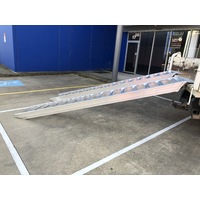

Enter the total height you need the ramp to climb. The calculator will show you the minimum ramp length required to meet different standard gradients.
Based on your entered height, here are the required ramp lengths for each use-case.
Taking the guesswork out of your ramp setup is crucial for safety, accessibility, and equipment protection. Whether you are installing a permanent wheelchair access ramp, bridging a rolled driveway kerb, or loading heavy machinery into a truck, calculating the correct gradient ensures you meet safety standards and prevent accidents.
Use our free Ramp Calculator above to instantly find your required dimensions, or read on to understand the science of slope ratios and Australian compliance standards.
Ramp steepness is measured as a gradient or ratio (e.g., 1:10 or 1:14). This ratio represents the Rise (the vertical height of the step) compared to the Run (the horizontal length of the ramp).
Example: A 1:10 ratio means that for every 1 unit of vertical height, you need 10 units of horizontal ramp length. If your step is 100mm high, your ramp must be 1,000mm (1 meter) long to achieve a 1:10 gradient.
The steeper the gradient (e.g., 1:4), the harder it is to climb and the higher the risk of slipping or scraping. The gentler the gradient (e.g., 1:14), the safer and more accessible the transition.
1. Wheelchair & Disabled Access Ramps (AS1428.1 Compliance) For commercial premises, public spaces, and NDIS-compliant home modifications in Australia, ramps must adhere strictly to AS1428.1 Design for Access and Mobility.
Standard Ramps: The maximum allowable gradient is 1:14. This provides a gentle, safe incline for independent manual wheelchair users.
Threshold Ramps: For very small height differences at doorways (maximum rise of 35mm), a steeper gradient of 1:8 is permitted.
Step Ramps: For heights up to 190mm, a 1:10 gradient may be used, provided the ramp length does not exceed 1,900mm.
2. Driveway and Kerb Ramps When calculating a kerb ramp to prevent a low-profile vehicle from scraping, a gradient between 1:8 and 1:10 is generally recommended. This creates a smooth transition that protects the vehicle's front spoiler and undercarriage without extending too far into the roadway.
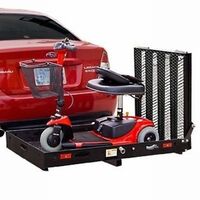
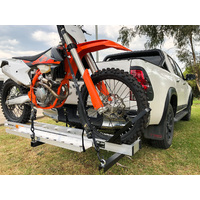
3. Machinery & Loading Ramps Loading heavy equipment (like excavators, ride-on mowers, or ATVs) into a trailer or truck bed requires factoring in the vehicle's ground clearance and wheelbase.
Driven Machinery: A gradient of 1:4 to 1:5 is usually the maximum safe limit to prevent the mower deck or chassis from "beaching" at the crest of the ramp.
Winch-Loaded: Equipment being winched can handle slightly steeper inclines, but you must ensure the ramp's load capacity rating is never exceeded.
To get the most accurate result from our calculator, you need a precise measurement of your Rise (Vertical Height).
Place a straight edge (like a piece of timber or a spirit level) flat on the top landing or step, extending out over the drop.
Use a tape measure to measure straight down from the bottom of the straight edge to the ground level.
Record this measurement in millimeters (mm) and input it into the calculator above.

Shop Now. Pay Later.
100% Interest-free.
Simple instalment plans available instantly at checkout
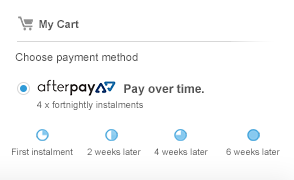

Select Afterpay as your payment method
Use your existing debit or credit card

Complete your checkout in seconds
No long forms, instant approval online

Pay over 4 equal instalments
Pay fortnightly, enjoy your purchase straight away!
All you need is:
1) A payment card; 2) To be over 18 years of age; 3) Resident of country offering Afterpay
To see Afterpay's complete terms, visit https://www.afterpay.com/terms
© 2026 Afterpay